
Going Beyond Manage: Getting More Value from IBM Maximo Application Suite
For many organizations, moving to IBM Maximo Application Suite (MAS) represents a major milestone in their asset management journey. Upgrading from a previous version of Maximo requires careful planning, technical preparation, testing, and coordination across multiple teams. By the time the migration is complete and the new environment is running smoothly, it's understandable that organizations may feel they've accomplished their primary objective.
But moving to Maximo Application Suite is only the beginning of what the platform can offer.
While Maximo Manage continues to provide the foundation for work management, preventive maintenance, inventory, purchasing, and other essential asset management activities, MAS introduces opportunities that extend well beyond those familiar capabilities. Organizations can explore more advanced approaches to understanding asset health, monitoring equipment performance, anticipating failures, improving field execution, and connecting maintenance information with broader operational decisions.
The challenge is determining what to do next. With so many capabilities available, it's not always clear which ones provide the greatest value, how they work together, or where an organization should focus its attention after completing a migration.
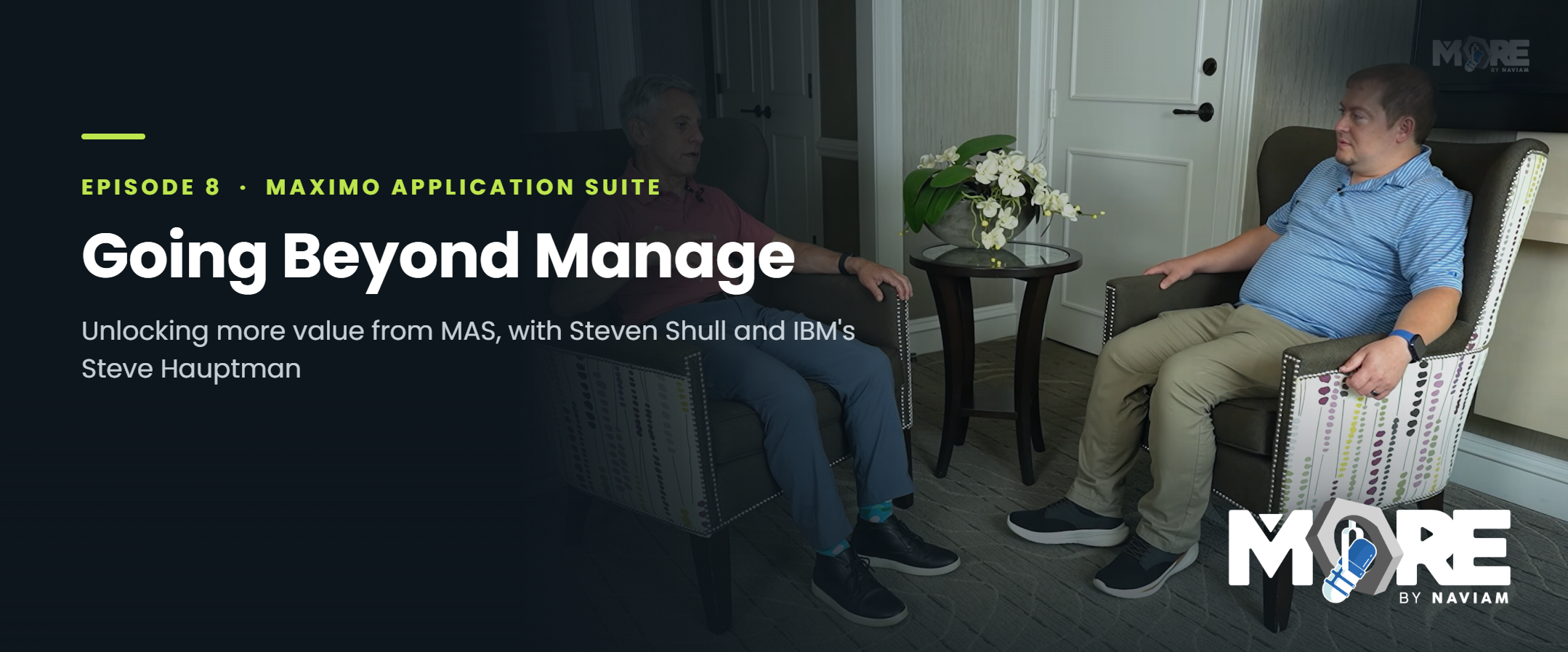
In Episode 8 of MORE by Naviam: A Maximo Podcast, host Steven Shull sits down with Steve Hauptman from IBM to discuss exactly that. Their conversation explores how Maximo teams can look beyond Manage and begin taking advantage of the broader Maximo Application Suite, including Health, Monitor, Predict, Scheduler, Mobile, HSE, Collaborate, and emerging AI capabilities.
For years, organizations have relied on IBM Maximo to manage the fundamental processes that keep their assets operating. Work orders, preventive maintenance schedules, asset hierarchies, inventory, and purchasing all play critical roles in helping maintenance teams organize and execute their work. Those capabilities remain essential, and for many organizations, they represent the primary reason Maximo is such an important business system.
However, the broader Maximo Application Suite creates opportunities to think about asset management differently. Rather than focusing exclusively on documenting maintenance activities and managing work, organizations can begin exploring how the information already captured in Maximo might support better operational decisions. That could mean identifying equipment deterioration earlier, understanding recurring maintenance patterns, improving how work is scheduled, or making relevant information more accessible to employees in the field.
One of the central themes Steven and Steve explore is that organizations don't need to adopt every capability within MAS at once. In fact, attempting to introduce too much functionality simultaneously can distract from the business challenges the technology is intended to solve. A more practical approach is to evaluate where the organization experiences operational friction today and determine which capabilities might help address those problems.
For an organization experiencing frequent unplanned downtime, that might mean examining asset health and condition monitoring. For another organization, the priority could be improving how technicians access information and complete maintenance activities. Others may want to simplify scheduling, make better use of their existing maintenance data, or explore how AI could support specific operational workflows.
The real opportunity isn't simply having access to a larger collection of applications. It's understanding how those applications can contribute to meaningful improvements in reliability, maintenance efficiency, and asset performance.
Most organizations using Maximo already collect substantial amounts of information about their assets. Work orders document maintenance activities, inspections capture observations, failure reports record equipment problems, and preventive maintenance histories provide insight into recurring work. Yet much of this information is primarily used to support individual transactions rather than to develop a broader understanding of asset condition.
That's where capabilities such as Maximo Health, Monitor, and Predict become particularly interesting. Together, they introduce opportunities to move from maintaining records of what has happened toward understanding asset condition and potentially anticipating what may happen next.
Maximo Health provides ways to assess assets using available condition information, criticality, and other relevant factors. Rather than relying entirely on individual work orders or inspection results, organizations can explore how multiple sources of information might contribute to an overall evaluation of an asset's health. This can help maintenance and reliability teams identify areas that deserve additional attention and make more informed decisions about where to direct resources.
During the episode, Steven and Steve spend time discussing the role of formulas and scoring. These capabilities can help organizations take information already stored within Maximo and translate it into indicators that are more useful for evaluating equipment condition. For example, an organization may have years of maintenance history available but lack a consistent method for interpreting that information across similar assets. Establishing relevant scoring criteria can provide a more structured approach to understanding differences in condition and risk.
Maximo Monitor extends the conversation by bringing operational data into the picture. For organizations with connected equipment or systems collecting measurements about asset performance, monitoring capabilities can provide additional visibility into changing operating conditions. Instead of relying exclusively on scheduled inspections or historical maintenance information, teams can explore how operational measurements contribute to a more current understanding of their assets.
Predict introduces another level of analysis by examining how data might be used to identify patterns associated with future equipment problems. This creates opportunities for organizations to evaluate predictive maintenance approaches where the available data, asset characteristics, and operational requirements support them.
The distinction between these capabilities matters, but their potential value becomes clearer when they're considered as part of a connected asset management strategy. Historical maintenance information, asset health evaluations, operational monitoring, and predictive analysis can each contribute different perspectives. Together, they can help organizations make maintenance decisions with a better understanding of equipment condition and potential risk.
Of course, introducing these capabilities doesn't eliminate the importance of data quality or operational expertise. Organizations still need to determine which information is meaningful, how asset condition should be evaluated, and whether analytical results accurately reflect what is happening in the field. The technology provides tools for working with information, but the value comes from applying those tools to real operational needs.
Understanding the condition of an asset is valuable, but that information becomes even more useful when it can influence how maintenance work is planned and completed. This is another area where looking beyond Manage can help organizations think more broadly about their Maximo environment.
During their conversation, Steven and Steve explore how Maximo Scheduler and Maximo Mobile fit into the larger picture. While Health, Monitor, and Predict focus on understanding assets and their condition, scheduling and mobile capabilities address the practical reality of organizing and performing maintenance activities.
Maintenance planning can be challenging even in relatively straightforward environments. Organizations must balance preventive maintenance requirements, corrective work, technician availability, competing priorities, equipment downtime, and operational constraints. When those factors aren't coordinated effectively, even well-defined maintenance processes can become difficult to execute consistently.
Scheduling capabilities can help teams organize maintenance activities and evaluate how available resources align with upcoming work. This becomes particularly valuable when organizations are trying to connect maintenance priorities with the people, time, and resources required to complete them.
Mobile work execution addresses another common challenge. Maintenance technicians frequently perform their work away from desktop computers, whether they're moving through a manufacturing facility, working on remote infrastructure, or inspecting equipment across a large site. Accessing work orders, reviewing asset history, completing inspections, recording labor, and documenting findings can become unnecessarily difficult when those activities depend on returning to a workstation or handling paper documentation.
Mobile capabilities can help bring those workflows closer to where the work actually happens. Technicians can access relevant information and document their activities in the field, supporting more timely updates and reducing the administrative burden associated with disconnected processes.
When these capabilities are considered together, the broader value of MAS becomes more apparent. Asset condition information may help inform which work should receive attention, scheduling supports how that work is organized, and mobile execution helps employees carry it out. The resulting maintenance records and observations can then contribute to the information available for future asset assessments.
Rather than thinking about each application as an independent technology investment, organizations can begin evaluating how these capabilities support a more connected maintenance process.
The conversation also examines capabilities that reach beyond traditional maintenance management, particularly artificial intelligence, health and safety processes, and collaboration tools.
As AI becomes increasingly prominent in enterprise software, asset-intensive organizations are understandably interested in how it could support their operations. However, the most useful applications of AI are likely to be those connected to clearly defined operational challenges rather than technology adoption for its own sake.
Steven and Steve discuss emerging AI capabilities within the Maximo ecosystem, including opportunities associated with analysis, image-based information, and defect detection. These examples illustrate how organizations may eventually be able to use intelligent capabilities to support activities that currently require significant manual interpretation or review.
For maintenance and reliability teams, the potential applications are broad. Equipment inspections often involve evaluating observations, recognizing changes in condition, and deciding whether additional work is needed. Operational systems produce large volumes of information that may contain useful patterns. AI-assisted capabilities can create opportunities to help users interpret information more efficiently, although the practical value of any approach depends on the use case, available data, and maturity of the technology.
Beyond AI, the episode explores Health, Safety, and Environment (HSE) capabilities and the ways asset management systems can support additional operational responsibilities. Steven and Steve discuss examples involving emissions and waste management, demonstrating how Maximo can play a role in workflows that extend beyond conventional work orders and equipment maintenance.
This reflects an important reality for many asset-intensive organizations: maintenance, reliability, environmental responsibilities, and operational performance are closely connected. The condition and operation of physical assets can influence safety, compliance, productivity, and business continuity. Technologies that help connect these areas may provide value beyond the maintenance department alone.
Another capability discussed is Maximo Collaborate, particularly in the context of remote expert support. Organizations operating across multiple facilities or geographic regions may have specialized technical expertise concentrated among a relatively small number of employees. When an unfamiliar or complex equipment problem occurs, having the right expert physically available isn't always practical.
Remote collaboration capabilities can help bridge that gap by supporting communication and technical assistance between employees working in different locations. For organizations managing geographically dispersed assets or teams, these tools present another way to improve access to knowledge and support field activities.
The broader lesson is that the value of Maximo Application Suite isn't limited to adding more maintenance features. It also creates opportunities to connect asset information, operational workflows, and specialized expertise across the organization.
As organizations consider expanding their use of MAS, one of the most important questions becomes how these different capabilities fit together. Introducing additional applications may provide access to new functionality, but the greatest opportunities often come from connecting information and processes that were previously handled separately.
Throughout the episode, Steven and Steve discuss relationships between Manage and other Maximo capabilities, including integration considerations and ways information can be used across the broader suite. They also touch on MBI and mobile AI-related functionality, highlighting additional opportunities for working with information in different contexts.
For organizations planning their next steps, this reinforces the importance of thinking about business workflows before selecting technology. A maintenance team may want to use asset health information to help prioritize work. A reliability engineer may need access to operational monitoring data when investigating equipment performance. A field technician may benefit from having relevant asset history and technical expertise available while performing an inspection.
Each of these scenarios involves different capabilities, but the underlying objective is similar: helping employees make better decisions by giving them access to relevant information when and where they need it.
That doesn't mean every organization will follow the same implementation path. Existing systems, available data, licensing, configuration, technical architecture, and business requirements will all influence which capabilities make sense. Some organizations may begin with relatively straightforward improvements to work execution, while others are prepared to explore more advanced asset performance management use cases.
What matters is approaching MAS with a clear understanding of the intended outcomes and evaluating how the broader capabilities can support those goals.
For Maximo teams that have recently completed a migration, or are still planning their move to MAS, the number of available capabilities can make it difficult to identify a logical next step. But the conversation between Steven and Steve suggests a practical starting point: focus first on the business problems that matter most, then determine which capabilities may help address them.
An organization experiencing recurring asset failures might begin by evaluating how existing maintenance and inspection data could contribute to asset health scoring. If additional operational data is available, monitoring and predictive capabilities may become part of that longer-term strategy. An organization struggling with maintenance coordination may see more immediate value in improving scheduling and field execution, while another may prioritize remote collaboration or specific AI-assisted workflows.
In many cases, the first step isn't a major technology deployment. It may be reviewing the quality of existing asset data, identifying gaps in current workflows, or understanding how information already collected in Manage could support more useful operational insights.
It's also important to recognize that getting more value from MAS is an ongoing process. Organizations don't need to establish a complete long-term roadmap for every available capability before beginning. Starting with a focused use case, evaluating its effectiveness, and building on successful results can create a more manageable path toward broader adoption.
Ultimately, going beyond Manage is about expanding the value of the Maximo environment, not simply expanding the number of applications being used. The most successful opportunities will be those that help employees work more efficiently, improve asset performance, reduce operational risk, or make better decisions based on available information.
Moving to IBM Maximo Application Suite is an important achievement, but the migration itself shouldn't be the final measure of success. The broader platform provides opportunities to build on the processes and information organizations already rely on, extending Maximo's role from managing maintenance activities toward supporting more connected asset management decisions.
Health, Monitor, Predict, Mobile, Scheduler, AI, HSE, Collaborate, and other capabilities each address different operational needs. Their value will vary from organization to organization, but together they demonstrate how the Maximo ecosystem is continuing to evolve beyond traditional enterprise asset management.
For teams already using MAS, the opportunity is to look at what comes next. For those still preparing to migrate, understanding these capabilities can help ensure the long-term strategy extends beyond simply replacing an existing system.
In Episode 8 of MORE by Naviam: A Maximo Podcast, Steven Shull and IBM's Steve Hauptman explore these opportunities and share perspectives on how organizations can begin getting more from the broader Maximo Application Suite.
Watch Episode 8: Going Beyond Manage with Steve Hauptman
Watch on YouTube | Listen on Spotify
Explore more technical conversations, practical tutorials, and product insights at MORE by Naviam: A Maximo Podcast.
Discover everything you need to know to modernize your asset management strategy.
Inside, you’ll learn:

ActiveG, BPD Zenith, EAM Swiss, InterPro Solutions, Lexco, Peacock Engineering, Projetech, Sharptree, and ZNAPZ have united under one brand: Naviam.
You’ll be redirected to the most relevant page at Naviam.io in a few seconds — or you can
go now.

.avif)