Perspectives from IBM EMEA Exchange in Madrid
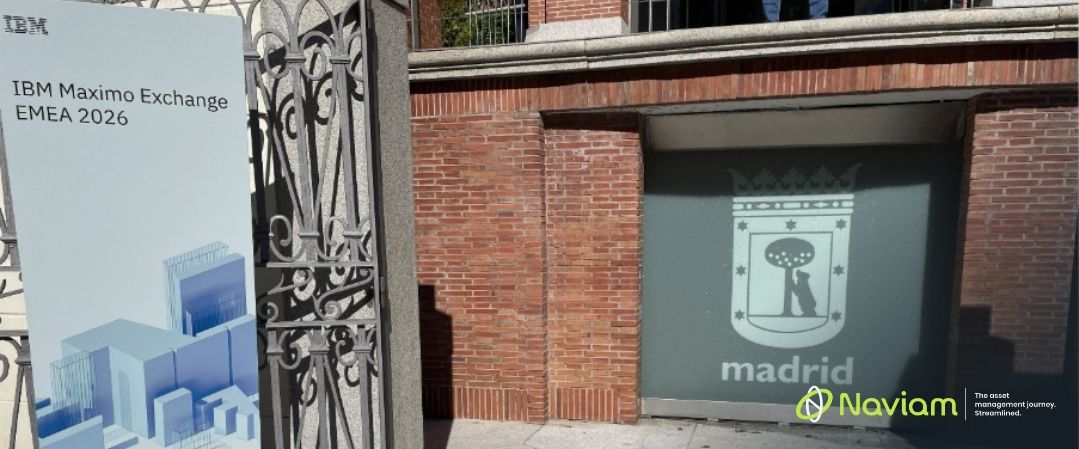
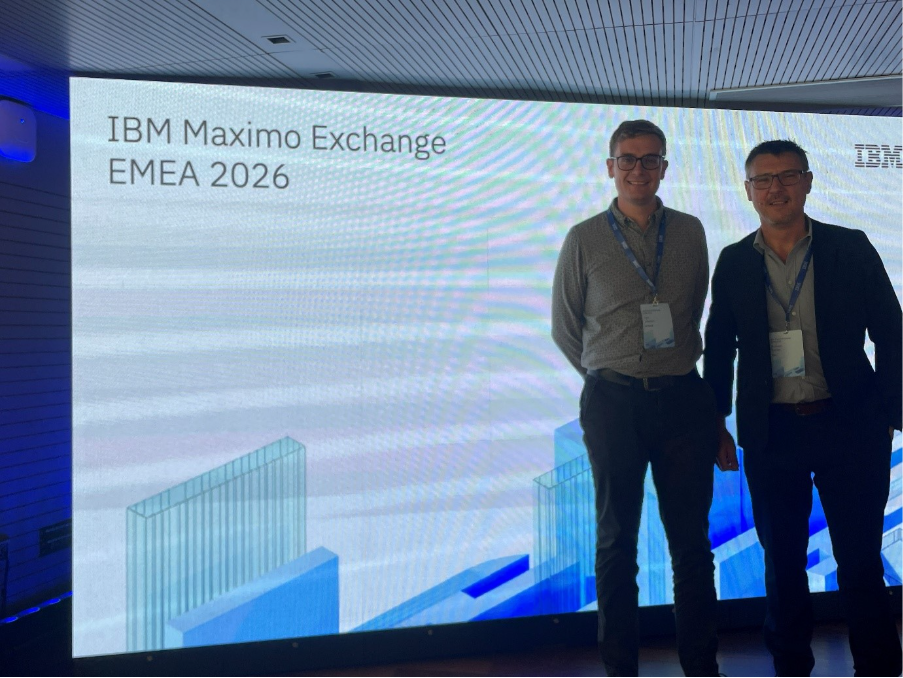
The IBM Maximo EMEA Exchange brought together representatives from 46 countries in a setting that could hardly have been more appropriate: Retiro Park, hosted by Madrid City Council. The park itself is full of assets, inventory, and spare parts managed as part of a complex municipal environment. I’m not sure where future events can go to top that.
Across the presentations, one message came through consistently. Maximo Application Suite is no longer being viewed simply as a work management system. Organisations are using it as a platform for resilience, standardisation, innovation, and, increasingly, AI-enabled decision-making.
Madrid City Council opened the event by explaining how three major crises had shaped its technology and asset management strategy.
COVID-19 exposed weaknesses in data and impact assessment. Storm Filomena demonstrated the importance of forecasting. The city-wide blackout in April 2025 reinforced the need to understand resources, dependencies, and operational priorities in real time.
In a crisis, the questions become very practical:
Madrid’s response is MINT, Madrid Intelligente, with Maximo at the heart of city operations. The platform supports 22 municipal services, five million geolocated assets, and three million tracked vehicle positions. It must help the city manage emergencies and major events while continuing to provide services to residents and visitors.
The Cloudvolution programme moved Madrid from a heavily customised, end-of-life Maximo 7.6 environment to a cloud-hosted platform designed for the future. The message from the programme was sensible and refreshingly direct: don’t go live until you have confidence in the solution.
Madrid’s ambitions now extend to an “agentic city”. This includes spatial context, treating images as first-class data, using Maximo Visual Inspection to identify issues from submitted photographs, and potentially enabling civil servants to create Maximo work orders through WhatsApp.
It was great to see a major European city so committed to the wider Maximo Application Suite. It also offers one possible explanation for why the streets of Madrid are so clean.
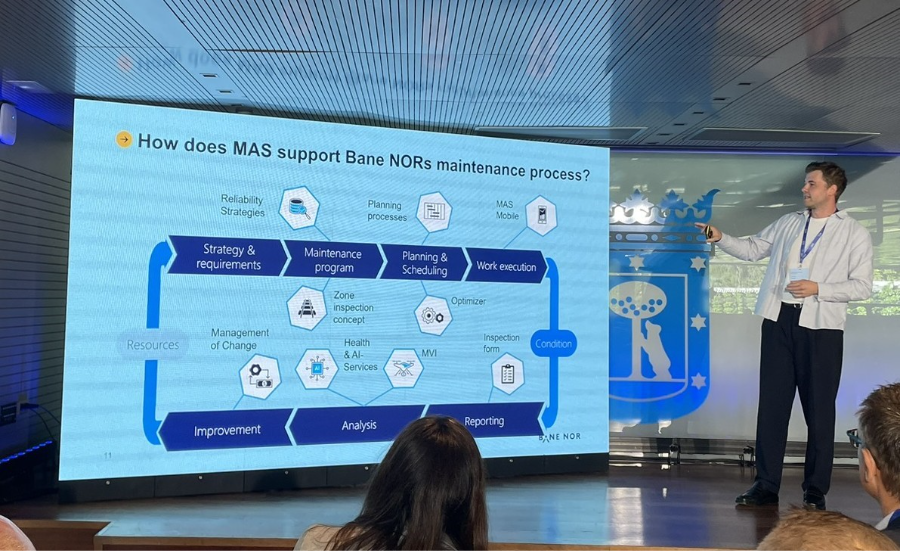
My strongest takeaway of the event came from Bane NOR.
The Norwegian rail organisation is using MAS as an innovation platform to transform railway maintenance. Crucially, it secured senior stakeholder support by mapping individual MAS applications against each stage of its maintenance lifecycle.
That created a clear connection between technology investment and operational value. It also supported an important decision: rather than heavily adapting MAS to reproduce existing ways of working, Bane NOR would change its business processes to use the suite as it was designed.
More organisations adopting MAS should consider this approach.
Bane NOR started with the Norway Maintenance Process, an established cross-industry standard. It is also using Maximo’s linear asset capabilities, an area that is sometimes overlooked despite its clear relevance to rail, roads, pipelines, and other distributed infrastructure. Planning is already delivering value, with Optimizer intended for future phases.
The broader lesson is that MAS adoption becomes easier to explain when applications are positioned against a recognisable business lifecycle. Instead of discussing products and features in isolation, organisations can show exactly where Manage, Mobile, Scheduler, Health, Monitor, and other capabilities support maintenance decisions.
El Corte Inglés described its migration from a legacy work management platform. Its strategic requirements included multi-site and multilingual support, extensive configuration without development, alignment with industry and retail maintenance practices, and integration with IoT and building management systems.
These requirements made MAS a strong candidate.
Its innovation roadmap now includes BIM integration, remote expert assistance, ESG emissions management, and asset health monitoring. However, one of the most immediate benefits has been mobility.
This is a useful reminder that transformation does not always need to begin with the most advanced capability. Giving technicians better access to accurate information at the point of work can deliver visible operational value while creating a foundation for the wider roadmap.
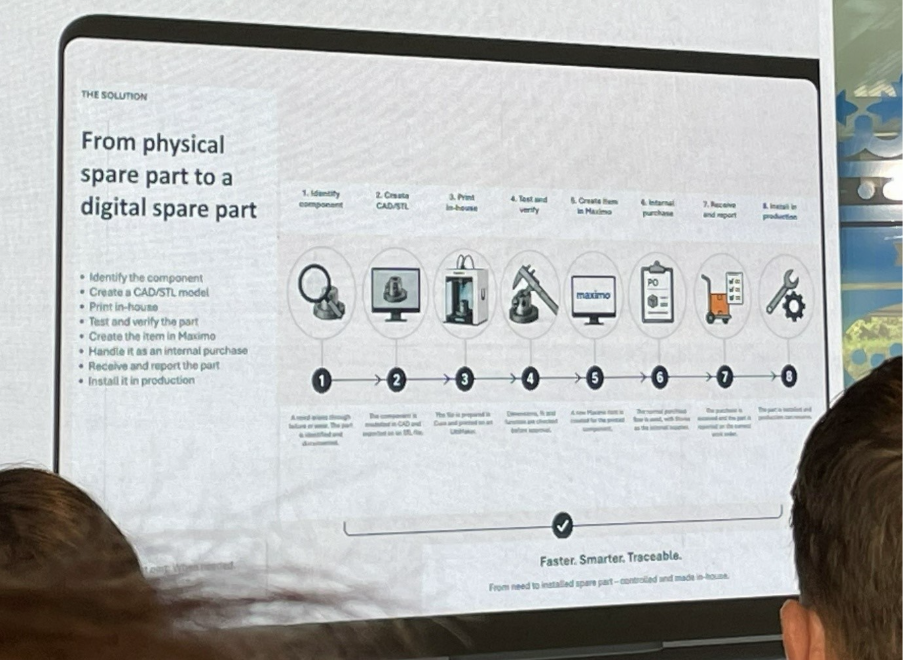
Spendrups, the Swedish brewery, presented one of the most distinctive use cases of the event: using 3D printing to manufacture spare parts and managing the process through Maximo.
Its four sites have different assets, maintenance requirements, and ages. Some require unique components that are no longer commercially available. In a production environment, even a very small unavailable part can stop an entire line, making obsolescence and lead times significant operational risks.
Additive manufacturing changes the model because the spare part can effectively become a digital asset. The process begins with preparing the CAD model, followed by printing, verification, fitting, and monitoring. Maximo remains at the centre, supporting demand identification, item creation, internal purchasing, goods receipt, installation, and subsequent work order history.
There is significant potential here. An item could be held in Maximo with its CAD drawing attached. Inventory reorder limits could initiate an internal purchase order when stock falls below an agreed threshold, with the resulting demand passed into the printing process. That moves 3D printing beyond a standalone experiment and makes it part of a governed maintenance and inventory process.
Michelin demonstrated the scale at which Maximo can operate: 80 sites, three regional organisations, 19,000 users, 28 million assets, and seven million work orders.
Its Michelin Maintenance Way defines maintenance standards using Bronze, Silver and Gold maturity levels. The organisation currently uses Maximo Manage and Scheduler, with Health and Mobile identified as future targets.
Michelin is already using a broad range of Manage capabilities, including assets, locations, inventory, and purchasing. Its scheduling ambitions include Graphical Work Week, Graphical Assignment, and Graphical Scheduling, with the objective of turning maintenance planning into measurable operational value.
The maturity approach stood out to me because it is similar to the capability modelling we are developing for DP World. Rather than expecting every site to reach an identical end state immediately, a tiered model establishes a controlled route from foundational capability to more advanced practices.
Michelin also highlighted a challenge that many organisations will recognise. It wants to extend field service management through Maximo Mobile, but there is a considerable gap between its current in-house mobile application and the Maximo Mobile Technician application. A sound roadmap needs to acknowledge those practical adoption gaps rather than assuming that deploying a new application automatically creates business readiness.
Quant described its journey from a Maximo Monitor proof of concept into production. As a maintenance management company responsible for 55 customer sites in Maximo, its goal is to establish a strong foundation for data-driven maintenance.
The identified value of Monitor includes:
Quant followed a structured approach through proof of concept, design, build, validation, pilot, and continuous rollout. It successfully established device configuration, data connectivity, and visualisation, while learning not to approach Monitor with predetermined expectations or simply compare it with existing IoT platforms.
Around 3,000 devices were imported for use in Monitor, with value becoming visible to technicians and operators. Quant’s next step is to upgrade to MAS 9.1 and adopt integration with Maximo Manage meters and Monitor metrics.
What I liked about this presentation was the focus on benefit realisation. The technology was important, but the journey was structured around proving where users would experience value.
Mitie demonstrated “Andy”, an in-house AI assistant operating with MAS. Authorised users can ask questions about data held in Maximo and receive answers in formats such as text or charts. This showed the potential for organisations to bring their own AI capabilities into the Maximo environment rather than relying on a single, fixed interaction model.
Facilities management provides an obvious area to explore. A conversational assistant could guide users through a series of questions, gather the information needed to classify an issue, and use the resulting data to support the creation of a service request or work order in Maximo Manage. The important point is not simply that users can chat with Maximo data. The opportunity is to make complex processes easier to access while maintaining appropriate authorisation and governance.
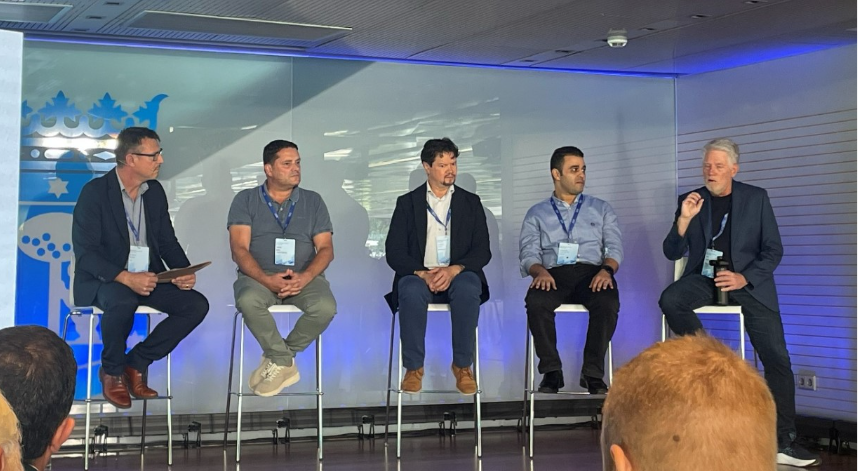
The roadmap discussion placed a strong emphasis on expanding AI across the suite. Plans discussed included bringing the AI assistant into the Maximo Mobile Technician application in MAS 9.3, scaling AI across Asset Lifecycle Management, and moving towards prescriptive maintenance.
IBM also wants to make the broader MAS portfolio easier to adopt. Users were encouraged to explore the generative AI capabilities in MAS 9.2, beginning with a simple question to the assistant: “What can you do?”
The direction was clear. AI is becoming a central part of the MAS roadmap and will increasingly be available to users and partners across the suite. However, the roundtable introduced an important reality check. Many organisations understand the potential of Asset Performance Management but believe they still have more fundamental priorities to address. The pace of new capability is faster than some organisations can absorb.
Maximo Health was suggested as an accessible place to start. I believe it could also be used to provide visibility of data quality, helping organisations understand the condition of the information underpinning their assets, not just the condition of the physical assets themselves.
The day may have ended with AI, but it repeatedly returned to data quality.
Organisations need standard asset, item and failure hierarchies if they want to take advantage of agentic AI, machine learning, prescriptive maintenance, and AI-generated insights. The recurring advice was straightforward:
The intended model is not AI replacing human judgement. It is AI providing people with better data, insights and context so that they can make better decisions. Keeping a human in the loop is also how organisations can build trust between operational users and AI agents.
The IBM Maximo EMEA Exchange demonstrated that the future of MAS is broader than any single application.
Madrid showed how Maximo can become part of a city’s operational resilience. Bane NOR demonstrated the value of aligning the suite to a standard maintenance lifecycle. El Corte Inglés highlighted mobility as an early transformation win. Spendrups showed how additive manufacturing can turn spare parts into governed digital assets. Michelin illustrated the importance of maturity models at global scale. Quant provided a practical path from connected data to operational value. Mitie demonstrated how organisations can bring their own AI agents into MAS.
Behind all these examples sits the same principle: advanced capability only creates sustainable value when it is built on good processes, usable standards, and trusted data.
AI may be the most visible part of the MAS roadmap, but organisations should resist the temptation to begin with the technology. Start with the operational decisions you need to improve. Map MAS to the maintenance lifecycle. Establish the necessary data foundation. Keep the solution as standard and simple as possible. Then use AI to make the value of that foundation easier to access.

Discover everything you need to know to modernize your asset management strategy.
Inside, you’ll learn:

ActiveG, BPD Zenith, Cohesive, EAM Swiss, InterPro Solutions, Lexco, Peacock Engineering, Projetech, Sharptree, and ZNAPZ have united under one brand: Naviam.
You’ll be redirected to the most relevant page at Naviam.io in a few seconds — or you can
go now.