IBM Maximo Data Imports Made Easier with DataStudio
Managing data in IBM Maximo is a critical part of keeping asset management operations running effectively. From asset records and location hierarchies to preventive maintenance schedules and job plans, the accuracy of information stored in Maximo directly influences how efficiently organizations can plan, execute, and track maintenance activities.
Yet importing and maintaining that information isn't always straightforward. Large datasets, inconsistent formatting, missing values, validation errors, and complicated approval processes can turn what should be a routine data update into a time-consuming project. For organizations managing thousands of assets or preparing for a Maximo implementation or migration, these challenges can become even more significant.
The problem often isn't simply the amount of data that needs to be managed. It's the effort required to ensure that information is accurate, properly structured, and ready to be committed to Maximo without introducing additional problems.
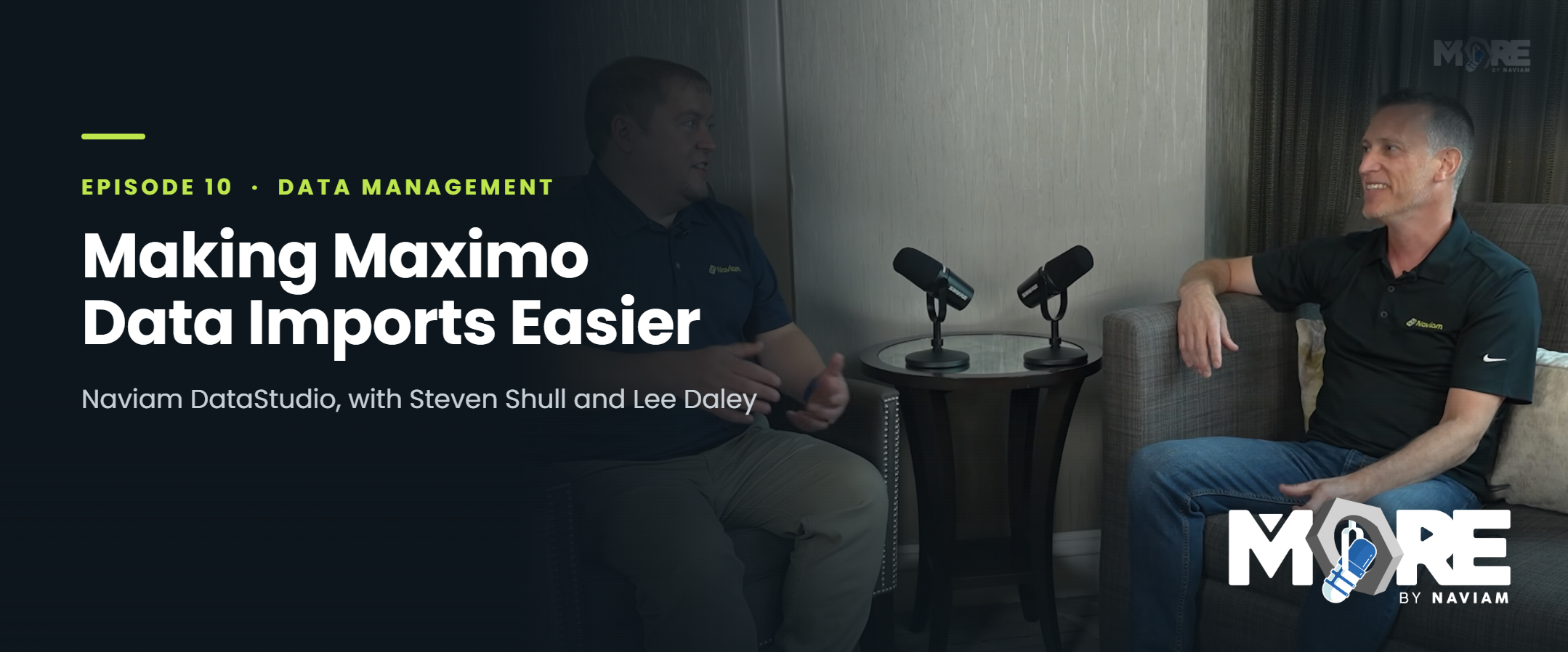
In Episode 10 of MORE by Naviam: A Maximo Podcast, host Steven Shull is joined by Lee Daley to explore how Naviam DataStudio can help simplify data imports and improve how organizations manage large datasets within IBM Maximo.
The conversation centers on an important part of successful enterprise asset management: making it easier for teams to work with their data while maintaining the accuracy, control, and governance that Maximo environments require.
IBM Maximo provides organizations with a central system for managing the information associated with their assets and maintenance operations. That information is essential to everyday business activities, but it also needs to be continuously maintained as equipment changes, new facilities are introduced, maintenance strategies evolve, and organizations expand their use of the platform.
Consider the amount of information involved in onboarding a new facility. An organization may need to create thousands of asset records, establish location hierarchies, define equipment relationships, populate specifications, and associate preventive maintenance requirements. Even when that information already exists in spreadsheets or another system, moving it into Maximo requires more than simply copying and pasting rows.
Each record must satisfy the relevant data requirements and business rules. Required values need to be populated, relationships must be accurate, and information has to be structured in a way that Maximo can accept. When errors occur, identifying the issue, correcting the original data, and repeating the process can create unnecessary rework.
These challenges aren't limited to initial implementations or large migration projects. Organizations also need to maintain existing data throughout the life of their Maximo environments. Asset descriptions change, classifications need to be updated, job plans evolve, and incomplete records require correction. Performing those updates individually may be manageable for a handful of records, but it becomes much more difficult when hundreds or thousands of changes are required.
Another common issue is the separation between the people who understand the data and the people who have the technical knowledge or permissions to load it. Maintenance planners, reliability engineers, and operational teams often know what needs to be changed, while Maximo administrators or technical specialists are responsible for actually making those changes. Without an efficient process for collaboration, even relatively straightforward data updates can involve multiple handoffs.
Naviam DataStudio is a web-based data management solution designed to help organizations query, edit, validate, approve, and upload large datasets in IBM Maximo. Its purpose is to make working with Maximo data more accessible while maintaining the controls that enterprise environments depend on.
One of DataStudio's most important capabilities is real-time data validation. Rather than requiring users to complete an entire data preparation process before discovering whether the information can be accepted, DataStudio can identify problems while the data is being reviewed and updated.
This allows teams to address issues involving required fields, formats, domains, and relevant business rules before changes are committed to Maximo. For organizations managing large data imports, catching these errors earlier can reduce the number of repeated loading attempts and make it easier to identify exactly which records require attention.
DataStudio also supports bulk data operations and reusable templates, helping teams manage larger volumes of information without needing to manually update each record. Templates can be used for different types of Maximo data, including assets, locations, preventive maintenance records, and job plans. By establishing consistent structures for common data activities, organizations can reduce repetitive work and create more predictable processes for importing and updating information.
For teams already working with spreadsheets, DataStudio's Excel-compatible workflows provide a familiar approach to managing large datasets. This is particularly useful when information originates outside Maximo, such as asset lists provided by equipment suppliers, survey teams, implementation partners, or other departments.
The ability to identify errors, make corrections, and prepare data within a more structured workflow can make a significant difference. Instead of treating a failed import as the starting point for troubleshooting, teams can address potential problems before the final data load takes place.
Speed is important when working with large datasets, but faster imports aren't valuable if they introduce inaccurate or inconsistent information into the system. For Maximo administrators and asset management teams, data quality and governance are just as important as efficiency.
DataStudio addresses this challenge through role-based access and workflow-driven approvals. Organizations can establish who is permitted to view, edit, approve, and commit data, allowing different individuals or teams to participate in the process while maintaining appropriate controls.
This is particularly relevant in organizations where business users are responsible for the accuracy of asset information but don't necessarily have the authority to make unrestricted changes to production data. With a controlled workflow, those users can prepare and review information while designated approvers evaluate changes before they're committed.
DataStudio is designed to work with Maximo's existing security model, helping organizations manage access through established Maximo security groups. It also keeps working data and approval-related information within Maximo, rather than relying on a separate external data repository.
These capabilities help address one of the more difficult aspects of enterprise data management: balancing accessibility with accountability. Teams need efficient ways to maintain information, but they also need confidence that changes are reviewed, traceable, and consistent with their organization's data management requirements.
The benefits extend beyond formal compliance processes. Clearer ownership, established approval steps, and consistent validation can reduce confusion over who is responsible for making changes and determining whether information is ready to be loaded.
While large data imports often receive the most attention during a Maximo implementation or migration, ongoing data maintenance can be equally important. Organizations continually discover records that need to be corrected, enriched, or standardized, particularly as they introduce new reporting requirements or expand their asset management capabilities.
For example, a reliability initiative may depend on having accurate equipment classifications, asset attributes, and location information. If those fields are incomplete or inconsistent, the organization may struggle to produce meaningful analysis even when the underlying technology supports it.
A tool such as DataStudio can help teams identify the records that need attention, update information in bulk, validate the proposed changes, and move them through the appropriate approval process. This makes it relevant not only for initial data loading but also for ongoing data cleansing and improvement activities.
The same principle applies to preventive maintenance records, job plans, and other structured information that needs to be maintained consistently across a Maximo environment. As business requirements change, teams need practical ways to update that information without creating excessive administrative work.
For organizations preparing to move to Maximo Application Suite, data quality also deserves attention as part of the broader migration process. Although a technically successful migration is essential, the usefulness of the resulting environment still depends heavily on the information it contains. Improving the quality and consistency of existing records can help organizations establish a stronger foundation for future improvements.
This becomes even more important as Maximo teams explore capabilities beyond traditional work management. Asset health analysis, monitoring, reporting, and other data-driven activities often depend on having reliable source information. Better data management processes can therefore support a much broader asset management strategy.
One of the most valuable opportunities in modern enterprise software is reducing the technical effort required to complete everyday business activities. That doesn't mean eliminating the need for experienced administrators or removing established controls. Instead, it means giving the people closest to the business process more effective ways to contribute.
In Maximo, that distinction is especially important because asset information often originates with teams outside the IT department. Maintenance planners understand job plan requirements. Reliability engineers know which asset attributes are important for their analysis. Operational teams may be responsible for capturing equipment information or validating records before a facility begins operating.
When these users can work with their information through more intuitive processes, organizations can reduce unnecessary dependencies and improve collaboration between business and technical teams.
DataStudio's approach to templates, validation, security, and approvals is designed to support that model. Business users can participate more directly in preparing and improving data, while administrators retain control over how information is committed to Maximo.
The result is a more manageable approach to data stewardship, where maintaining accurate information becomes part of an ongoing operational process rather than a series of disconnected technical tasks.
Importing data into IBM Maximo is only one part of effective data management. Organizations also need to ensure that information is accurate, consistently structured, reviewed by the appropriate people, and maintained as business requirements evolve.
For many Maximo teams, the greatest opportunity is to improve the process surrounding the data itself. Catching errors before they reach the system, reducing manual updates, establishing reusable templates, and creating clearer approval workflows can help organizations improve both efficiency and information quality.
Naviam DataStudio provides a way to bring these activities together within a controlled Maximo data management workflow, making it easier to manage large datasets while maintaining visibility and accountability.
In Episode 10 of MORE by Naviam: A Maximo Podcast, Steven Shull and Lee Daley introduce the topic of simplifying Maximo data imports with DataStudio and the broader opportunity to make data management more manageable for the people responsible for it.
For organizations dealing with large data imports, ongoing cleanup activities, or the challenges associated with maintaining accurate asset information, it's a useful conversation about an often-overlooked part of successful enterprise asset management.
Watch Steven Shull and Lee Daley discuss Naviam DataStudio in Episode 10 of MORE by Naviam: A Maximo Podcast.
Watch Episode 10 on YouTube | Listen to Episode 10 on Spotify
Learn more about Naviam DataStudio, or request a demo to see how it could support your Maximo data management processes.
Explore additional episodes of MORE by Naviam: A Maximo Podcast for practical conversations, technical insights, and product discussions from across the IBM Maximo ecosystem.

Discover everything you need to know to modernize your asset management strategy.
Inside, you’ll learn:


ActiveG, BPD Zenith, EAM Swiss, InterPro Solutions, Lexco, Peacock Engineering, Projetech, Sharptree, and ZNAPZ have united under one brand: Naviam.
You’ll be redirected to the most relevant page at Naviam.io in a few seconds — or you can
go now.