
Maximo Manage to Maximo Application Suite: A Practical Adoption Roadmap for MAS Manage Users

For many organisations, IBM Maximo has been the cornerstone of maintenance and asset management for decades. Work orders, preventive maintenance, inventory, procurement and asset records are deeply embedded in daily operations, generating growing volumes of data and increasing organisational reliance on the platform.
Many organisations still view Maximo primarily as an Enterprise Asset Management (EAM) platform, while some continue to treat it solely as a Computerised Maintenance Management System (CMMS). This perception can limit the value they seek from the wider Maximo Application Suite.
The introduction of Maximo Application Suite (MAS) has extended Maximo beyond traditional EAM and CMMS, bringing together work management, Asset Performance Management (APM), mobility, operational monitoring, scheduling, reliability, and AI-enabled capabilities within a single integrated platform. While Maximo Manage remains the foundation of the suite, the wider MAS ecosystem provides organisations with new opportunities to improve reliability, optimise resources, connect operational technologies, and move towards predictive maintenance strategies.
For existing Maximo users, the question is no longer simply whether to move to MAS. It is how to sequence adoption of the broader capabilities so that each investment addresses a defined operational need, builds on a stable foundation and delivers measurable business value.
Organisations rarely create value by implementing every MAS application simultaneously. A phased journey is more practical: strengthen core processes and data first, digitise work execution next, connect operational data when the foundations are stable, and then introduce APM and AI capabilities where they address a defined business need.
Before introducing advanced applications, organisations should ensure:
Strong data quality and maintenance discipline form the foundation for Asset Performance Management (APM), Condition-Based Maintenance (CBM) and Predictive Maintenance (PdM).
For many organisations, the greatest initial benefits come from implementing:
These capabilities enhance existing maintenance processes and often deliver rapid improvements in workforce productivity and maintenance effectiveness.
Once maintenance execution processes are mature, organisations can introduce Maximo Monitor to connect operational technology such as:
This enables real-time monitoring, anomaly detection and operational visibility across critical assets.
With maintenance and operational data connected, organisations can begin leveraging:
These applications support condition-based and risk-based maintenance strategies, helping organisations make more informed maintenance and investment decisions.
Once asset health and predictive maintenance capabilities have matured, organisations can extend further into AI-driven inspections through Maximo Visual Inspection (MVI).
MVI enables organisations to train computer vision models to identify defects, anomalies and conditions using images and video, reducing manual inspection effort and improving inspection consistency.
The table is a starting point rather than a prescriptive sequence. Priorities will depend on each organisation’s asset criticality, operational constraints, data maturity and business objectives, but the comparison highlights where different industries commonly begin and how their adoption journeys may evolve.
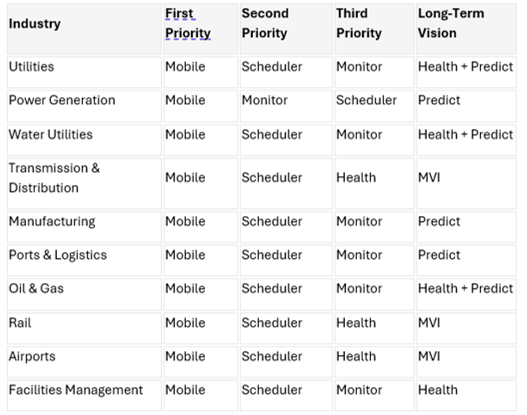
One consistency remains across industries: organisations often generate the quickest return on investment through Mobile and Scheduler, FSM, because they directly improve maintenance execution, workforce effectiveness and data quality.
For many organisations, Maximo Mobile is the logical first step beyond Manage because it strengthens maintenance discipline while generating the higher-quality data needed for future APM and PdM initiatives.
Data is captured at the point of work, reducing delays and improving accuracy.
Failure codes, causes and corrective actions are captured more consistently, creating valuable information for reliability and maintenance improvement programmes.
Technicians spend less time travelling to offices or updating records from desktop workstations.
Maintenance activities can continue in remote and disconnected environments.
Many organisations invest heavily in planning maintenance work but struggle to execute that work efficiently.
Common challenges include:
Scheduler extends the work management capabilities of Maximo Manage through a suite of graphical scheduling, assignment, dispatching and resource-management tools. It helps organisations move beyond planning and into optimised execution by ensuring the right work is assigned to the right resource at the right time.
Utilities use Scheduler to coordinate outage programmes and field resources. Manufacturers align maintenance schedules with production requirements. Ports coordinate maintenance activities across critical operational assets. Oil and gas operators optimise turnaround and shutdown planning. Transportation organisations manage geographically dispersed maintenance teams.
For organisations with mature maintenance processes, Scheduler often delivers some of the most visible improvements in operational performance.
Once Mobile and Scheduler have improved maintenance execution and data quality, organisations are positioned to unlock greater value through APM capabilities.
Monitor provides real-time visibility of operational and condition data, helping organisations identify anomalies before they become larger operational issues.
Health provides a consolidated view of asset condition, criticality, risk and business impact, helping organisations prioritise maintenance and investment decisions using a consistent asset health framework.
Predict applies machine learning and historical asset performance data to identify failure patterns, estimate future risk, and support predictive maintenance decision-making.
MVI enables organisations to train AI-powered computer vision models that automatically identify defects, anomalies and asset conditions from images and video.
Together, these applications support the journey from reactive maintenance towards condition-based, predictive and ultimately prescriptive asset management.
The transition from Maximo Manage to the wider suite is not simply a software upgrade; it is a phased journey towards connected, intelligent and proactive asset management. Organisations should first strengthen Manage, then use Mobile and Scheduler to improve execution and data quality before introducing Monitor, Health, Predict and Visual Inspection where the business case and operational maturity support them.
Typically, I would expect organisations to follow a clear progression:
For most organisations already running mature Maximo work management processes, Mobile and Scheduler often provide the fastest route to measurable business value. Together they improve work execution, data quality, workforce utilisation and maintenance planning while establishing the foundations required for Asset Performance Management (APM), Condition-Based Maintenance (CBM), Predictive Maintenance (PdM) and AI-enabled reliability programmes.
The future of asset management is not simply about managing work orders more efficiently. It is about connecting people, processes, operational data and intelligence across the entire asset lifecycle. For organisations beginning their journey from Maximo Manage into the wider Maximo Application Suite, the opportunity is not only to improve maintenance execution, but to build a roadmap towards smarter, safer and more reliable asset performance management.
Discover everything you need to know to modernize your asset management strategy.
Inside, you’ll learn:

ActiveG, BPD Zenith, EAM Swiss, InterPro Solutions, Lexco, Peacock Engineering, Projetech, Sharptree, and ZNAPZ have united under one brand: Naviam.
You’ll be redirected to the most relevant page at Naviam.io in a few seconds — or you can
go now.


.avif)