
Protección de Maximo DocLinks en MAS: resolución del requisito de GID fijo en OpenShift

**Before diving in, I want to acknowledge the research and analysis in this piece is entirely thanks to the outstanding work of Rahul Raju, Senior Maximo Consultant with Naviam, and Murali Shunmugaraja, Cloud and Dev Ops Lead with Yarra Valley Water.
Migrating existing Maximo deployments, specifically transitioning from Maximo 7.6.1 to Maximo Application Suite (MAS) on OpenShift, often presents a critical challenge concerning persistent storage access: the DocLinks volume.
This post details the vital configuration steps required to ensure that Maximo workloads successfully access and interact with existing NetApp NFS volumes by enforcing a fixed Group ID (GID), thereby overcoming standard OpenShift dynamic security constraints.
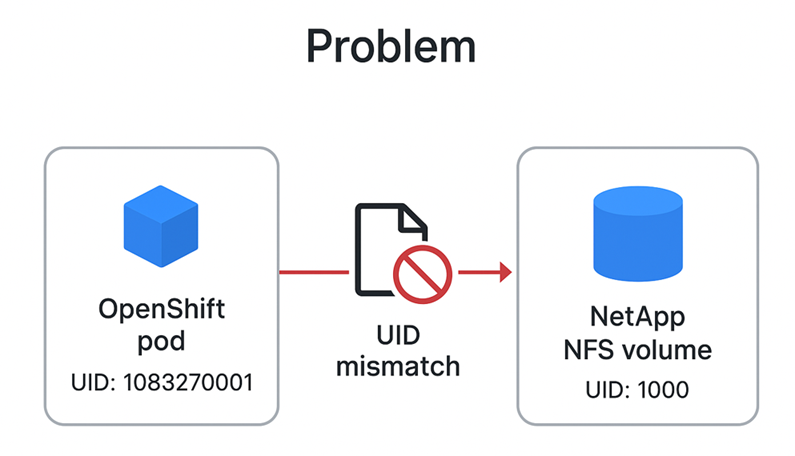
In the legacy Maximo 7.6.1 environment, DocLinks volume access was provisioned using fixed Linux User IDs (UIDs) and Group IDs (GIDs), let us say 1000 and 1001 respectively, associated with specific users (wasuser, wasgroup).
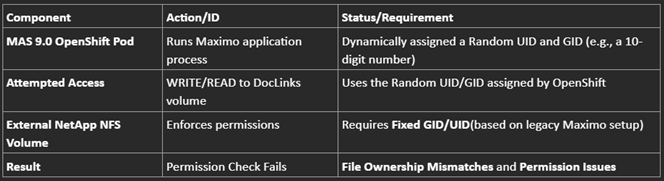
However, the MAS 9.0 environment on OpenShift introduces a conflict:
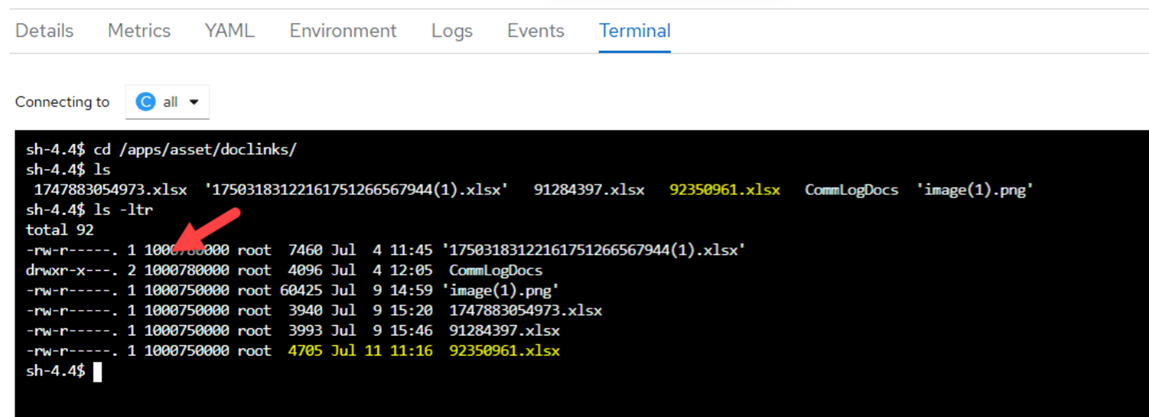
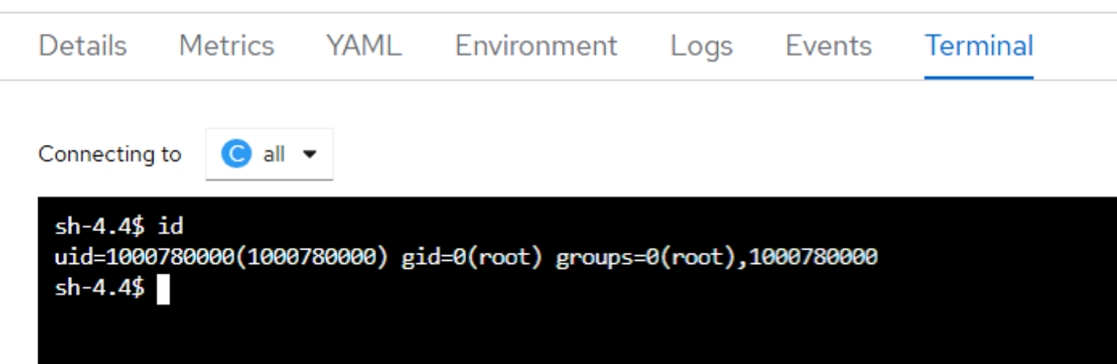
Because the containerized Maximo workloads use a random, dynamically assigned UID to access the volume, while the volume expects a fixed UID (specifically 1000), we encounter file ownership mismatches and permission issues when attempting actions like file uploads.
For our existing NetApp volume patterns to function correctly, it is vital that OpenShift communicates to the volume on a fixed UID/GID, such as 1000/1001, instead of using a random UID or the root group. We need a specific fsGroup or Group ID to handle read/write access.
To compel OpenShift to use the required fixed GID 1001 when accessing the DocLinks volume, we leverage OpenShift's Security Context Constraints (SCCs) and apply specific changes to the ManageWorkspaces Custom Resource Definition (CRD) instance.
First, we create an SCC that mandates the exact fixed GID we need. This resource sets permissions on specific OpenShift controls.
The critical setting ensures that the fsGroup MustRunAs GID 1001:
# SCC Snippet: mas-test-manage-SCC
fsGroup:
type: MustRunAs
ranges:
- min: 1001 # Define the minimum allowed GID
max: 1001 # Define the maximum allowed GID
supplementalGroups:
type: RunAsAny
volumes: ['*']
# ... other standard non-privileged security settings ...
We save this definition (e.g., ./mas-test-scc.yaml) and apply it using command
oc apply -f ./mas-test-scc.yaml
Complete example of such yaml file is shared below:
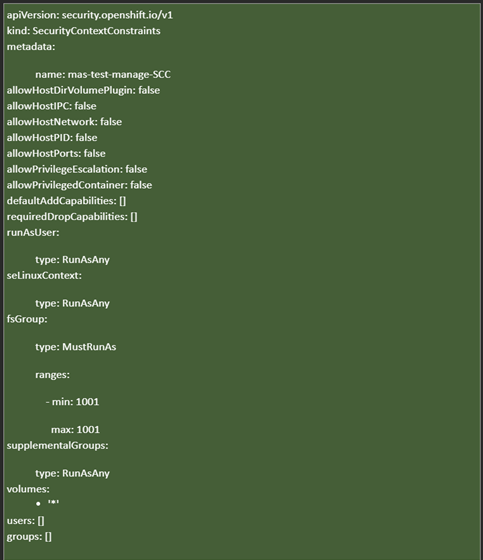
Next, we must bind this custom SCC (mas-test-manage-securitycontext) to the service account responsible for creating the Maximo pods (e.g., ibm-mas-manage-manage-deployment):

Two final operational updates are necessary:
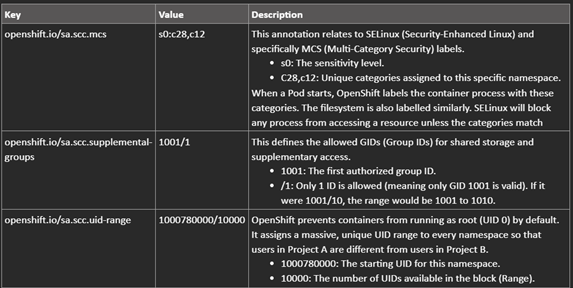
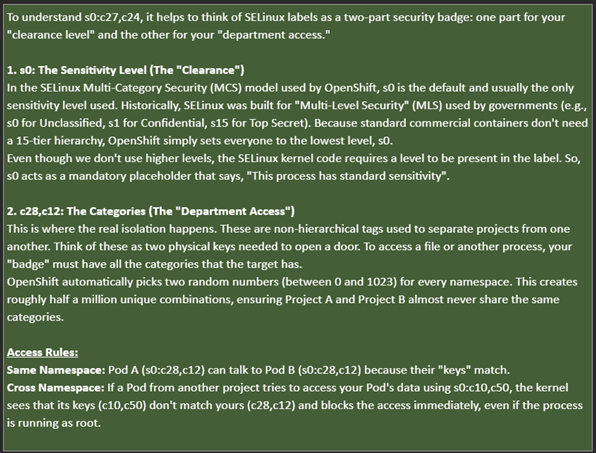
The securityContext must enforce runAsGroup: 1001 across all relevant Maximo workloads. This fixed GID must be applied to the following workload templates defined in the CRD:
Example snippet applied to the manageWorkspaces CRD instance:
podTemplates:
- name: manage-maxinst
securityContext:
runAsGroup: 1001 # Enforce the fixed GID
supplementalGroups:
- 0
- name: all
Contexto de seguridad:
Funciona como grupo: 1001
Grupos suplementarios:
- 0
#... repita para jms, mea, cron, ui, report...
Al definir Funciona como grupo: 1001, se garantiza que todos los contenedores que acceden al volumen de DocLinks utilizan el GID histórico correcto, lo que resuelve el antiguo desajuste de permisos.
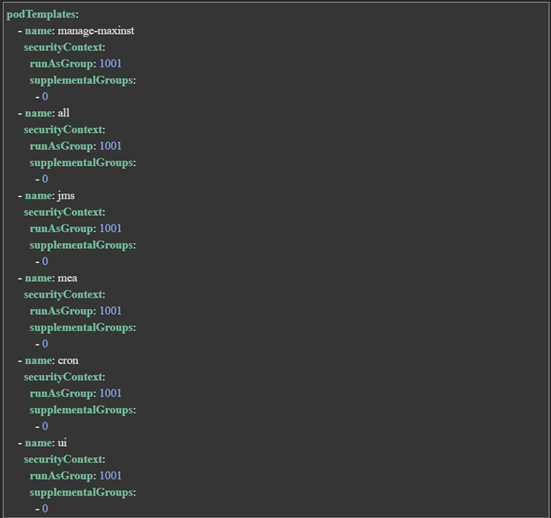
En resumen, una vez que estos cambios se apliquen al espacio de nombres de OpenShift, todos los pods implementados en él heredarán y se ejecutarán con el GID configurado (por ejemplo, 1001), lo que garantiza una aplicación coherente del contexto de seguridad en todas las cargas de trabajo.
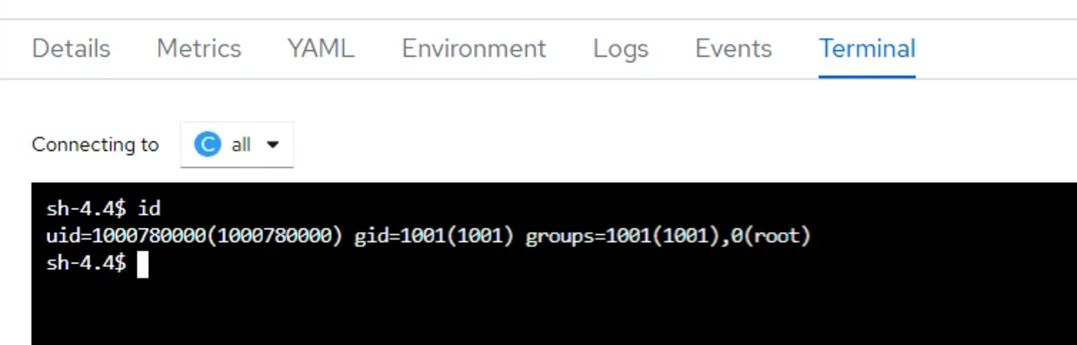
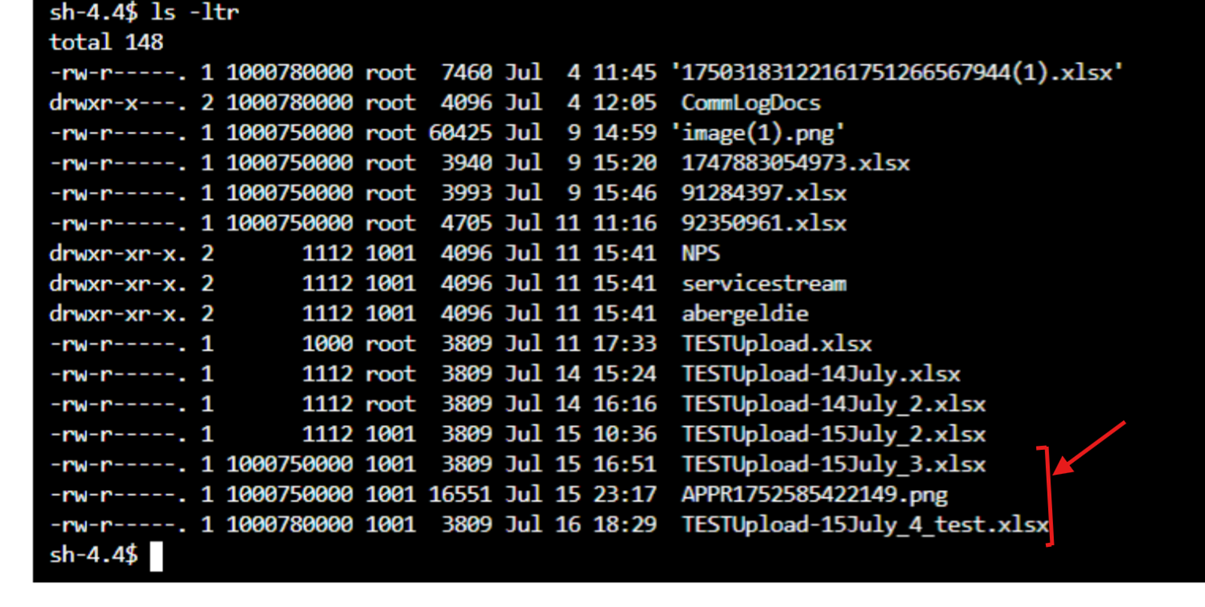
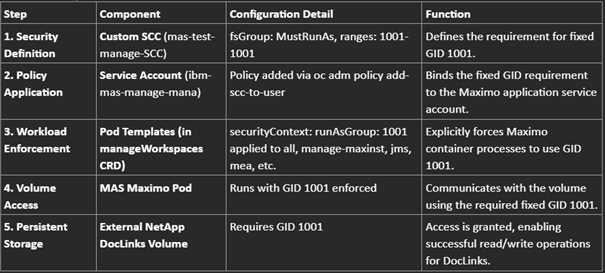
Este enfoque estructurado garantiza una migración exitosa y una funcionalidad continua de la persistencia de DocLink tras la actualización a Maximo Application Suite 9.0 en OpenShift.
Nota: - La política de seguridad a nivel NFS se actualizó para definir la restricción de acceso únicamente a nivel GID (1001). Corregir un UID constante para OpenShift No se recomienda usar pods, especialmente si planeas hospedar varios entornos en el mismo clúster. Por lo tanto, cualquier restricción definida a nivel de UID debe suprimirse o redefinirse a nivel de GID.

Discover everything you need to know to modernize your asset management strategy.
Inside, you’ll learn:


ActiveG, BPD Zenith, EAM Swiss, InterPro Solutions, Lexco, Peacock Engineering, Projetech, Sharptree, and ZNAPZ have united under one brand: Naviam.
You’ll be redirected to the most relevant page at Naviam.io in a few seconds — or you can
go now.



.avif)