Asset Management Plans are a fundamental component of ISO55001: 2024  Asset management — Asset management system — Requirements published by the ISO Committee and focus specifically on the requirements for a robust asset management system. The standard details the criteria necessary for establishing, implementing, maintaining, and improving an asset management system.

Have you ever struggled with the effort required to implement an Asset Management Plan in the Maximo Application Suite?

This is often due to numerous challenges when trying to populate MAS using the wording in an Asset Management Plan requiring an interface to translate between the authors of the Asset Management plans into actionable information the Maintenance team use to execute the plan.

Naviam has the team to transform your Asset Management Plans into live, data-driven, optimised maintenance and operating models within the Maximo Application Suite.

Asset Management Plans

Naviam’s team provides a comprehensive approach to implementing an Asset Management Plan (AMP) within Maximo, transforming the AMP into a structured, governed, and continuously optimised system which satisfies all the needs of an organisations many stakeholders.  

Our approach integrates asset and maintenance strategies, scheduling, cost alignment, and performance monitoring using MAS, its dashboards and KPIs. Including:

  • Structured AMP Design and Configuration: translating the AMP into a detailed system design including asset hierarchy, criticality, maintenance strategies, and KPIs, configuring these elements in Maximo to create a foundational asset model essential for AMP delivery
  • Automated Maintenance Strategy Execution: Core AMP elements such as preventive maintenance, inspections, and condition-based triggers are implemented as automated work generation within Maximo, ensuring the AMP maintenance strategy is actively executed  
  • Advanced Scheduling and Work Management: Naviam standardizes work management with defined work types, priorities, workflows, and safety steps, while aligning AMP execution with advanced scheduling and optimization tools to optimize resource allocation and work execution
  • Performance Monitoring and Continuous Improvement: MAS 9 dashboards provide real-time KPI monitoring and actionable work queues, and establishes a continuous improvement loop based on KPI performance, work history, and failure trends to refine and optimize the AMP dynamically  


Lets dive into some more details on the individual elements of an AMP and where Maximo and Naviam do assist our clients.

The Core Principle

Naviam implements the AMP as a configured, governed system inside Maximo.

In simple terms:

  • AMP defines “what should be done”
  • Maximo defines “how it is executed”
  • MAS dashboards & KPIs define “how well it is working”
  • Naviam focuses on “how all of this is designed, configured, and continuously improved”

Naviam Implementation Approach (End-to-End)

Naviam follows a structured delivery model that transforms an AMP into Maximo configuration.

Step 1: Translate AMP into Structured Design

Naviam starts by breaking the AMP into design components.

Key outputs:

  • Asset hierarchy model
  • Criticality model
  • Maintenance strategy (e.g. PM / CBM / RCM)
  • KPI framework
  • Scheduling model


Key outcome: AMP becomes a structured data and process model (not a document).

Step 2: Configure the Asset Foundation in Maximo (Builds the asset backbone for AMP delivery)

Naviam configures:

  • Asset hierarchy (sites → systems → assets)
  • Classifications & attributes
  • Asset criticality scoring
  • Failure codes and taxonomy


Why this matters: All KPIs, PMs, scheduling logic depend on this foundation.

Step 3: Implement the Maintenance Strategy (Core AMP requirement)

This is the heart of AMP implementation.


Naviam implements:
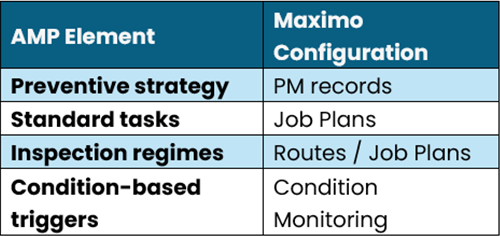
Result: AMP maintenance strategy becomes automated work generation.

Step 4: Configure the Work Management Model

Naviam standardises execution using:

  • Accurate Work Planning
  • Work types (such as PM / CM / EM)
  • Priority rules
  • Workflow approval processes
  • Safety and compliance steps
  • Accurate completion and history records for Optimised Work

Outcome: Consistent work execution and improved KPI accuracy for Maintenance team performance

Step 5: Implement Scheduling & Optimisation (Advanced Layer)

Naviam aligns Work management with a suite of Graphical Scheduling applications.

Configuration includes:

  • Team structures
  • Shift patterns
  • Travel and location logic using spatial techniques
  • Work priority rules

Result: AMP is not just executed. It is optimised to efficiently deploy the maintenance workforce.

Step 6: Materials & Cost Alignment

Naviam ensures the Work management Model aligns to supply chain:

  • Spare parts linked to job plans
  • Inventory levels and reorder rules
  • Tracking material and service costs on work orders

This also supports financial and lifecycle decisions long term.

Step 7: Implement MAS 9 Dashboards & KPIs (Critical Layer)

This is where the AMP becomes visible and measurable configuring multiple views of KPI’s to suit each group  of stakeholders.

MAS 9 Operational Dashboards

Acts as a live control center with actionable views for operational decisions providing:

  • KPI cards (performance metrics)
  • Work queues (actionable lists)
  • Workflow assignments
  • Quick actions

The dashboard allows users to:

  • Monitor KPIs
  • View overdue work
  • Drill into work orders directly
Extend the KPI Framework

Naviam expands such KPI sets to align with ISO 55001 as:


Reliability KPIs

  • MTBF (Mean Time Between Failures)
  • MTTR (Mean Time to Repair)


Maintenance KPIs

  • PM compliance
  • Planned vs reactive work (PMP)


Execution KPIs

  • Work order completion rate
  • Backlog


Scheduling KPIs

  • Schedule compliance
  • Break-ins / break-outs


These KPIs provide measurable insights into asset performance and maintenance effectiveness.  

Step 8: Establish Continuous Improvement Loop

ISO 55001 requires ongoing improvement. Naviam establishes the information to provide the insights for review cycles.


Inputs

  • KPI performance
  • Work order history
  • Failure trends

Outputs

  • Adjust PM frequency
  • Update job plans
  • Refine scheduling rules
  • Optimise workforce allocation


This ensures: The AMP is continuously optimised, not static.

Key Differentiators of Naviam’s MAS Approach

“Configuration-Led Asset Management Plans"

AMP is built into Maximo (not external).

Strong Scheduler Alignment

Deep integration with:

  • Resource planning
  • Optimisation  

KPI-Driven Design

  • KPIs defined before configuration
  • Ensures measurable outcomes

MAS 9 Dashboard Enablement

  • Operational dashboards replace static reports
  • Enables real-time control

Continuous Improvement Model

  • Regular optimisation cycles
  • Driven by KPI performance

In summary, Naviam implements Asset Management Plans in Maximo by:

  1. Translating the AMP into structured configuration
  1. Embedding it into Maximo (PMs, job plans, scheduling, workflows)
  1. Enabling MAS 9 dashboards and KPIs to monitor performance
  1. Applying governance and continuous improvement to optimise outcomes


For more information or assistance, please contact your local Naviam representative team or visit our Contact Us page.
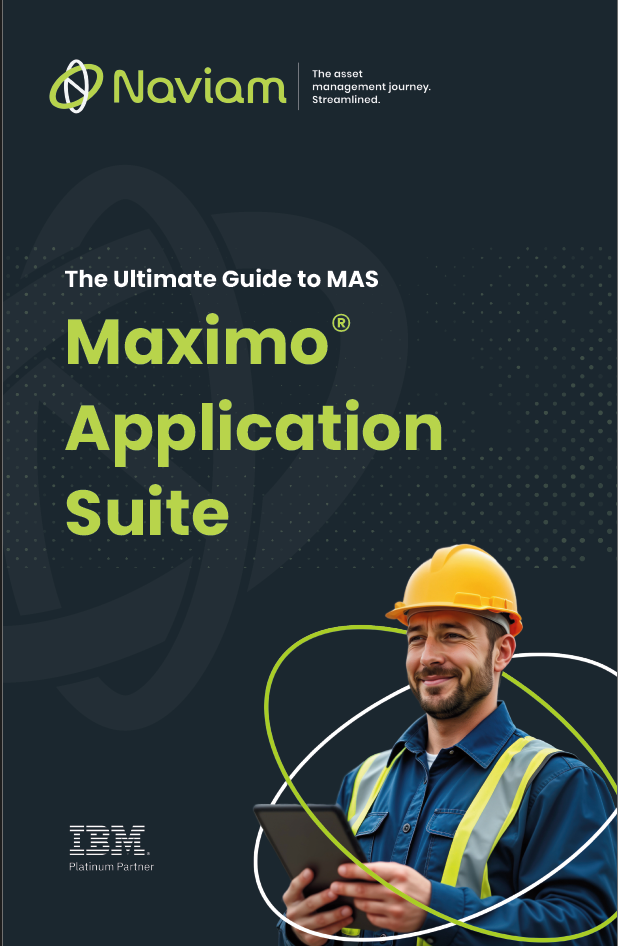
Unlock the Ultimate Guide to IBM Maximo Application Suite (MAS)

Discover everything you need to know to modernize your asset management strategy.

Inside, you’ll learn:
  • What’s new in IBM Maximo Application Suite 9.0
  • Key differences between Maximo 7.6 and MAS
  • How AppPoints and OpenShift change the game
  • Industry use cases across energy, manufacturing, and transportation
  • Step-by-step guidance for upgrading and migration readiness
Cover of 'The Ultimate Guide to MAS Maximo Application Suite' by Naviam featuring a man in a yellow construction helmet and safety vest holding a tablet.
×

ActiveG, BPD Zenith, EAM Swiss, InterPro Solutions, Lexco, Peacock Engineering, Projetech, Sharptree, and ZNAPZ have united under one brand: Naviam.

You’ll be redirected to the most relevant page at Naviam.io in a few seconds — or you can go now.
Read Press Release