
Transforming Asset Management in Energy & Utilities with IBM Maximo Health

Energy and Utilities (E&U) companies face unique challenges in providing affordable, reliable, and sustainable energy to their customers. These challenges come in many forms including aging assets, an aging workforce, maintenance maturity, intermittency, and unpredictable issues.
To address these challenges, utilities need to evolve their maintenance strategies from reactive maintenance towards condition/health-based and predictive maintenance.
Utilities need to take advantage of the data (wealth of assets) coming from various sources and use them to their fullest potential to gain a profound understanding of their assets.
Transformers are critical components that play a central role in voltage regulation and power distribution. However, the current landscape faces several challenges, including recurring breakdowns even after preventive maintenance and excessive maintenance costs that exceed the budget.
Customers need to shift away from conventional approval-based maintenance methods and adopt condition-based and predictive maintenance strategies. In today’s digital landscape, we have access to an extensive range of asset data, from sensors, meters, and operational systems to historical records and environmental inputs. When leveraged effectively, this information enables organizations to perform proactive, intelligence-driven asset maintenance.
One powerful solution that supports this transformation is IBM Maximo Health, which uses real-time and historical data to deliver actionable insights into asset condition and future performance.
Factors/Contributors that impact the well-being of a transformer include:
IBM Maximo Health provides away to improve the performance of assets by getting better insight into the health of assets. Health is derived by utilizing the data from OT and IT systems and with the help of prebuilt formulas.
Let’s take a practical example of a transformer asset and explore how different contributors influence its overall Health Score. In this scenario, we will consider six key contributors derived from both IT and OT data sources. These contributors collectively shape the asset’s condition and provide a clear picture of its operational health.
Below are the contributors:

Manage the health of your assets by leveraging IoT sensor data, asset records, and work history to enhance asset availability and support smarter replacement planning. With intuitive dashboard visualizations, you gain a clear, evidence-based view of asset condition, enabling informed prioritization of operational decisions such as refurbishment, repair, or replacement.
Below is a short demo showcasing the end-to-end process of configuring the Health Dashboard for any asset, starting from identifying the assets to reviewing the final output. The video already includes these steps, and I will walk through each one in detail.
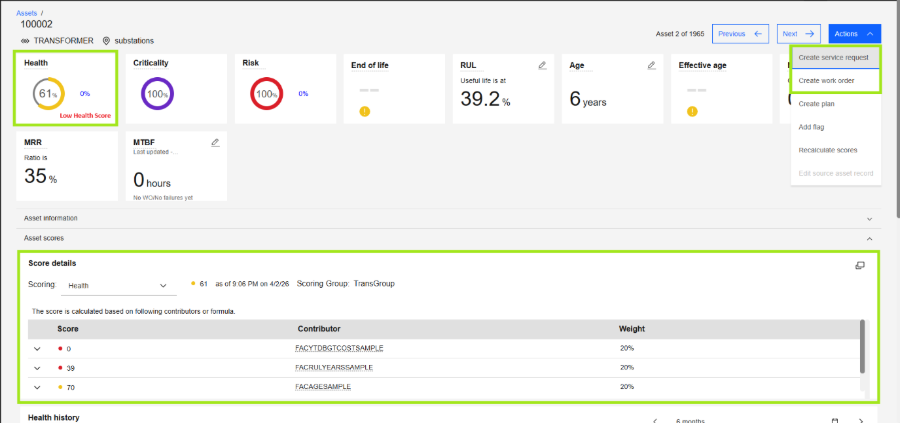
Once the Asset Health Score is derived using a combination of OT data, IT data, maintenance history, IoT readings, and environmental factors, the next crucial step is acting on those insights. An Asset Health Score is only valuable when it helps maintenance teams make informed, timely decisions that prevent failures, reduce costs, and improve reliability.
This is where IBM Maximo Health seamlessly connects insights to action.
When a transformer or any critical asset shows a declining health trend or crosses a defined threshold, Maximo enables users to immediately initiate maintenance activities. Depending on the severity and business rules, users can:
A Service Request is ideal when:
With a single click from the Health dashboard, users can open an SR pre-populated with WOs.
A Work Order is created when immediate action is required.
For example:
From the Health module, users can initiate a WO directly tied to the asset’s health condition.

Discover everything you need to know to modernize your asset management strategy.
Inside, you’ll learn:


ActiveG, BPD Zenith, EAM Swiss, InterPro Solutions, Lexco, Peacock Engineering, Projetech, Sharptree, and ZNAPZ have united under one brand: Naviam.
You’ll be redirected to the most relevant page at Naviam.io in a few seconds — or you can
go now.


.avif)